CBSE Class 10 English — First Flight
First Flight is the main reader for CBSE Class 10 English, and its prose and poetry carry the bulk of the Literature section in the board paper. Knowing each text well — not just the story, but the themes, the devices and the way the board frames its questions — is what turns reading into marks.
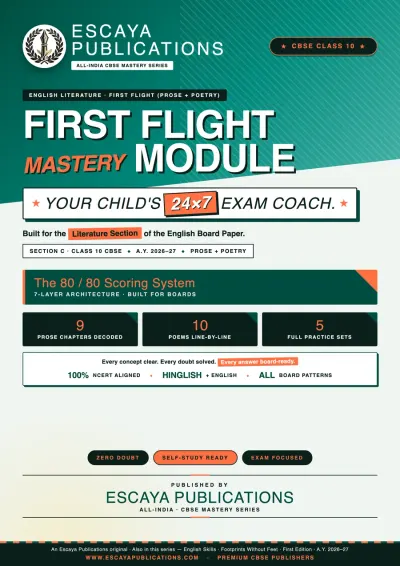
These free guides cover all nine prose chapters and all ten poems: a clear summary, the key points and themes, the most-asked board questions with answer pointers, and the traps that cost students marks. They are the same thinking behind the Escaya First Flight module, opened up for everyone.
Board paper — at a glance
First Flight supplies most of the Literature section. Expect extract-based questions (1–2 marks), short-answer questions (2–3 marks) and long-answer questions (around 5–6 marks) from both prose and poetry. Themes, character and poetic devices are tested as often as the storyline.
Chapter-wise guides
- 01A Letter to God · G.L. FuentesA poor farmer's unshakeable faith collides with human dishonesty
- 02Nelson Mandela: Long Walk to Freedom · Nelson MandelaOne man's journey from a personal dream of freedom to a nation's liberation
- 03Two Stories about Flying · Liam O'Flaherty & Frederick ForsythTwo flights, two kinds of fear, and the courage it takes to fly
- 04From the Diary of Anne Frank · Anne FrankA lonely teenager turns a blank diary into her truest friend
- 05Glimpses of India · Lucio Rodrigues, Lokesh Abrol & Arup Kumar DattaThree short journeys into the bread, hills and tea of India
- 06Mijbil the Otter · Gavin MaxwellA writer adopts a playful otter and falls under its spell
- 07Madam Rides the Bus · VallikkannanA curious little girl plans one secret bus ride into the wide world
- 08The Sermon at Benares · Betty RenshawA grieving mother's search for a cure that does not exist
- 09The Proposal · Anton ChekhovA marriage proposal that keeps collapsing into silly quarrels
- 10Dust of Snow · Robert FrostA small, ordinary moment in nature quietly rescues a heavy mood
- 11Fire and Ice · Robert FrostDesire and hatred, imagined as the two forces that could end the world
- 12A Tiger in the Zoo · Leslie NorrisA caged tiger's quiet rage at a freedom that has been taken away
- 13How to Tell Wild Animals · Carolyn WellsA mock guide to identifying dangerous beasts — usually by being attacked
- 14The Ball Poem · John BerrymanA lost ball becomes a child's first lesson in grief and letting go
- 15Amanda! · Robin KleinA scolded child escapes into daydreams to find the freedom she craves
- 16The Trees · Adrienne RichTrees breaking out of a house — a quiet image of freedom reclaimed
- 17Fog · Carl SandburgFog imagined as a cat that arrives, watches, and quietly moves on
- 18The Tale of Custard the Dragon · Ogden NashThe 'cowardly' dragon turns out to be the bravest of them all
- 19For Anne Gregory · W.B. YeatsA gentle argument that real love must be for the soul, not the looks
Every First Flight chapter, run through the 7-Layer System.
- The X-Ray A one-page chapter skeleton — every concept mapped at a glance.
- Concept Builder Every idea opened up with NCERT lines and real-world analogies.
- Answer Architecture Exact answer skeletons for 1, 2, 3 and 5-mark questions.
- Case Study Cracker Source-based questions decoded line by line.
- Exam Twists CBSE's repeating trick questions, mapped and solved.
- Rapid Fire Every MCQ, assertion-reason and fill-in, drilled to reflex.
- Exam Room Playbook Exam-day strategy — time, order, recovery.
Frequently asked — First Flight, Class 10
- How many chapters and poems are there in Class 10 First Flight?
- The current CBSE First Flight has nine prose chapters and ten poems, all of which are covered in these free guides.
- Are the poems important for the Class 10 English board exam?
- Yes. Poems appear in the Literature section through extract-based and short/long-answer questions, and poetic devices are tested directly — so the poems are as important as the prose.
- How should I revise First Flight for the board exam?
- For each text, fix the summary and theme first, then the key points and devices, and finally practise the board-pattern questions. Each guide here is built in exactly that order.