CBSE Class 10 · Democratic Politics – II
CBSE Class 10 Civics (Political Science)
Class 10 Civics (Democratic Politics – II) is about ideas — power sharing, federalism, democracy — and the board rewards clear definitions, the right textbook examples (Belgium, Sri Lanka), and crisp cause-and-effect reasoning.
These free guides give each chapter a clean summary, the key points and definitions, the board-pattern questions, and the traps students fall into (swapped examples, blurred distinctions). The Escaya approach — free to read.
Board paper — at a glance
Civics is part of the 80-mark Social Science paper. Expect MCQ/objective items (1 mark) and short and long answers (3 and 5 marks). Definitions, "distinguish between" questions, and the standard examples from the textbook are tested again and again.
Chapter-wise guides
- 01Power SharingWhy sharing power is the very spirit of a democracy
- 02FederalismHow power is shared between the centre and the states
- 03Gender, Religion and CasteHow social differences shape politics — for better or worse
- 04Political PartiesThe vehicles that connect citizens to government
- 05Outcomes of DemocracyWhat democracy actually delivers — and what it promises
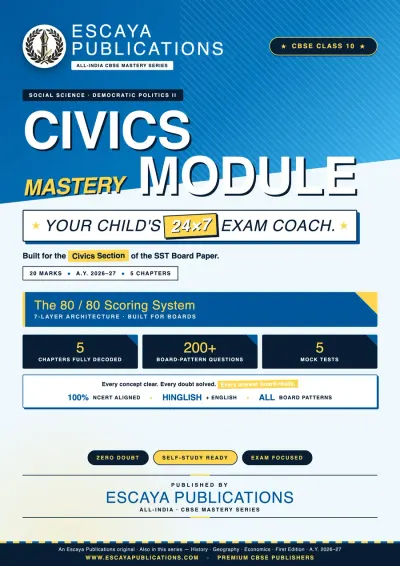
The Civics Mastery Module
Every Civics chapter, run through the 7-Layer System.
- The X-Ray A one-page chapter skeleton — every concept mapped at a glance.
- Concept Builder Every idea opened up with NCERT lines and real-world analogies.
- Answer Architecture Exact answer skeletons for 1, 2, 3 and 5-mark questions.
- Case Study Cracker Source-based questions decoded line by line.
- Exam Twists CBSE's repeating trick questions, mapped and solved.
- Rapid Fire Every MCQ, assertion-reason and fill-in, drilled to reflex.
- Exam Room Playbook Exam-day strategy — time, order, recovery.
Frequently asked — Civics, Class 10
- How many chapters are there in Class 10 Civics?
- Democratic Politics – II has five chapters for the board — Power Sharing, Federalism, Gender Religion and Caste, Political Parties, and Outcomes of Democracy — all covered here.
- Why are Belgium and Sri Lanka so important in Civics?
- They are the running examples for power sharing — Belgium shows accommodation, Sri Lanka shows majoritarianism. Examiners use them constantly, so knowing both well is essential.
- How do I score full marks in Civics answers?
- Open with a precise definition, give the textbook example, and finish with the reason or effect. Each guide is structured to build exactly this kind of answer.