CBSE Class 10 History
History in CBSE Class 10 (India and the Contemporary World – II) is dense with events, dates and causes — and the board rewards students who can organise that detail into clear, structured answers rather than just retell the story.
These free guides break every chapter into a clear summary, the key points and dates worth memorising, the board-pattern questions that recur, and the traps that cost marks (mixed-up dates, swapped leaders). Built the Escaya way — free to read.
Board paper — at a glance
History sits within the Social Science paper (80 marks total across History, Geography, Civics and Economics). Expect objective/MCQ items (1 mark), source-based questions, and short and long answers (3 and 5 marks). Dates, causes-and-effects and the ability to compare are tested heavily.
Chapter-wise guides
- 01The Rise of Nationalism in EuropeHow the idea of the nation-state spread across nineteenth-century Europe
- 02Nationalism in IndiaHow Gandhi turned scattered protests into one mass freedom struggle
- 03The Making of a Global WorldHow trade, migration and money slowly stitched the world together
- 04Print Culture and the Modern WorldHow the printed word reshaped ideas, religion and society
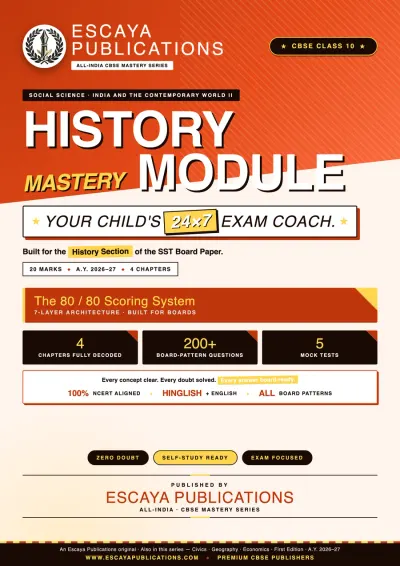
Every History chapter, run through the 7-Layer System.
- The X-Ray A one-page chapter skeleton — every concept mapped at a glance.
- Concept Builder Every idea opened up with NCERT lines and real-world analogies.
- Answer Architecture Exact answer skeletons for 1, 2, 3 and 5-mark questions.
- Case Study Cracker Source-based questions decoded line by line.
- Exam Twists CBSE's repeating trick questions, mapped and solved.
- Rapid Fire Every MCQ, assertion-reason and fill-in, drilled to reflex.
- Exam Room Playbook Exam-day strategy — time, order, recovery.
Frequently asked — History, Class 10
- How many History chapters come in the Class 10 board exam?
- For the board exam, four chapters are central — The Rise of Nationalism in Europe, Nationalism in India, The Making of a Global World, and Print Culture and the Modern World — all covered here.
- How do I remember all the dates in Class 10 History?
- Anchor each movement to one or two key dates and link events as cause and effect rather than memorising a long list. Each guide highlights only the dates examiners actually test.
- Are source-based questions important in History?
- Yes. The paper includes source/passage-based questions, so practise reading a short extract and answering precisely from it — a skill these guides build through their question pointers.